Industrial PVC hoses are used in a wide range of technical systems because they combine flexibility, relatively low weight and the possibility of adapting hose construction to different operating conditions.
They can be found in ventilation systems, extraction installations, material handling applications and various industrial machines.
However, the term “PVC hose” covers many different constructions.
A hose intended for air movement may have very different properties from one designed for suction, handling abrasive particles or operation in a particular temperature range.
For this reason, proper selection should always start with the application rather than with hose diameter alone.
What is an industrial PVC hose?
PVC, or polyvinyl chloride, is widely used in technical hose production.
Depending on the hose design, PVC can offer a useful combination of flexibility, low weight, transparency and resistance suitable for many industrial applications.
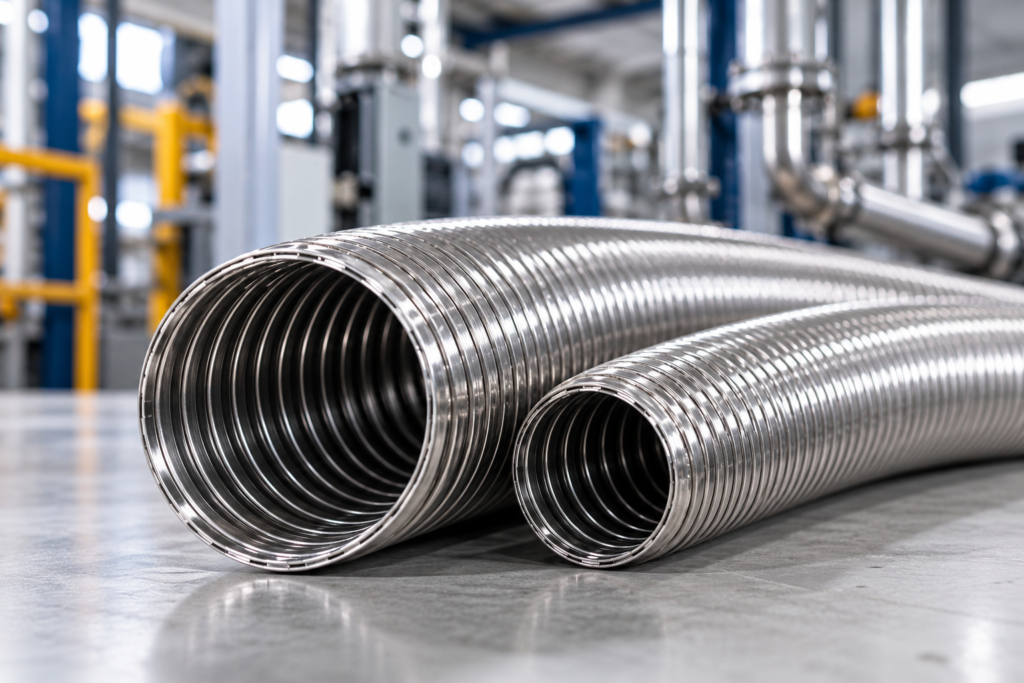
The final properties of a PVC industrial hose depend not only on the base material but also on its construction.
A hose may include reinforcement, a spiral, a specific wall thickness or other structural elements designed to improve its performance in a particular application.
This is why two PVC hoses with the same nominal diameter may behave very differently in operation.
Where are industrial PVC hoses used?
Extraction and ventilation systems
PVC hoses can be used to move air or process exhaust in technical installations where flexibility is required.
The exact hose type should be selected according to airflow, temperature and system pressure.
Light material handling
Certain PVC hose constructions can be suitable for transporting lightweight particles or other materials.
In these applications, abrasion behaviour and hose wall construction become especially important.
Machinery and production equipment
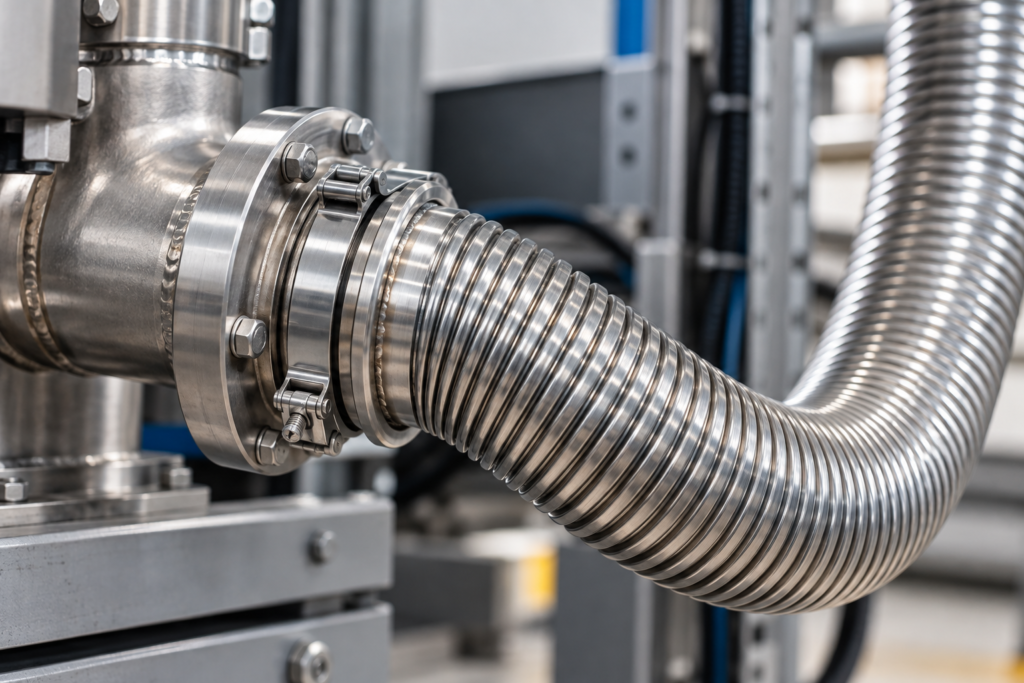
A flexible hose can connect parts of a machine where a rigid pipe would be difficult to install.
This is useful when space is limited or when small movements occur during operation.
Technical suction applications
Some PVC hoses are designed for suction systems.
For this type of application, vacuum resistance and resistance to hose collapse should be checked carefully.
Key parameters when selecting a PVC hose
1. Hose diameter
The hose diameter affects flow capacity and pressure losses.
It also needs to match existing connections and the overall design of the installation.
Choosing a smaller diameter only because it is easier to install can reduce system efficiency.
2. Temperature range
PVC has a defined operating temperature range.
The actual permitted values depend on the specific formulation and hose construction.
Both medium temperature and ambient temperature should be taken into account.
3. Vacuum resistance
In suction systems, the hose needs to maintain its shape under negative pressure.
A hose that is too soft or insufficiently reinforced may deform and restrict flow.
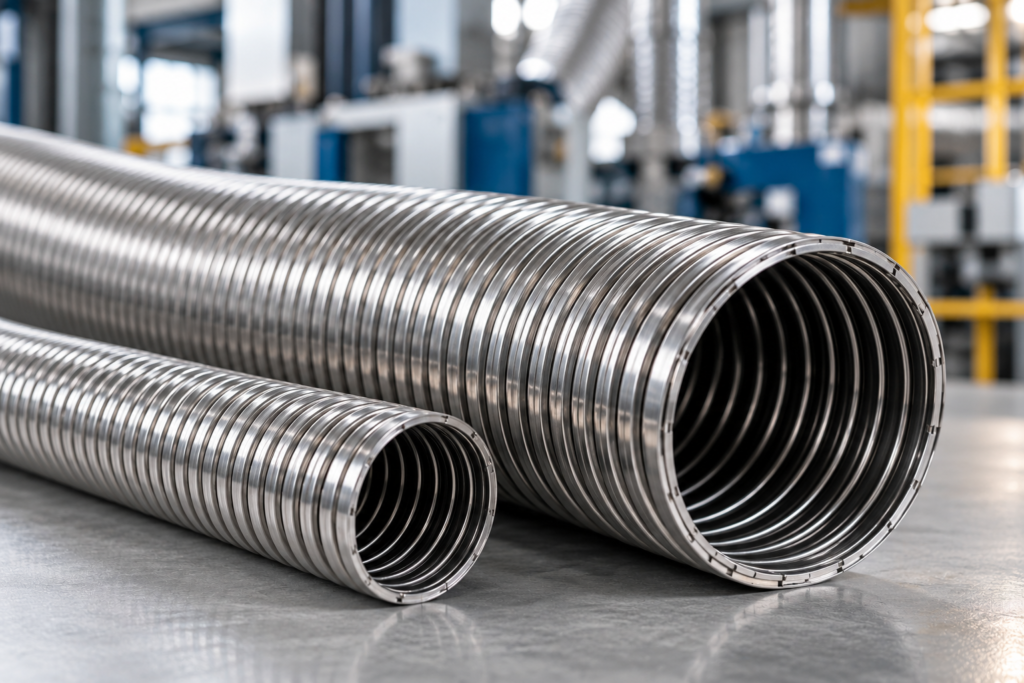
4. Flexibility and bend radius
Installation geometry often determines how flexible a hose needs to be.
A smaller installation space typically requires a more flexible construction, but the manufacturer’s minimum bend radius should always be respected.
5. Abrasion
If particles move through the hose, the inner surface may be exposed to continuous wear.
In abrasive applications, hose material and wall thickness need to be evaluated carefully.
In some processes, a polyurethane hose may be a better choice than PVC.
6. Chemical compatibility
The transported medium must be compatible with the hose material.
Chemical resistance should be verified for the actual substance, concentration, temperature and exposure conditions.
PVC hose versus PUR hose
PVC and polyurethane hoses are both common in industrial systems, but they should not be treated as interchangeable materials.
PVC can be an effective solution for many general technical applications, ventilation systems and certain suction processes.
PUR is often selected when higher abrasion resistance is required, especially in systems transporting dust, chips or other abrasive particles.
This means that the correct choice is determined by the process.
Instead of asking whether PVC or PUR is “better”, it is more useful to ask which material provides the required properties for the application.
Why hose construction matters
Users often focus primarily on material and diameter.
In reality, hose construction may be equally important.
Reinforcement type, wall thickness, spiral geometry and overall flexibility influence how a hose behaves under vacuum, during bending and under mechanical load.
For industrial installations, this can directly affect service life and operating stability.
Common mistakes when selecting a PVC hose
One common mistake is selecting a hose purely by diameter.
Another is assuming that every PVC hose offers the same temperature or vacuum resistance.
Problems can also occur when the hose is installed with an excessively tight bend or exposed to a medium for which the material is not suitable.
A more reliable selection process takes into account the complete operating environment:
temperature, medium, pressure or vacuum, mechanical stress, installation geometry and required service life.
Industrial PVC hoses from RONDO
RONDO supplies technical hose solutions for a wide range of industrial applications.
When selecting a hose, the aim should be to match its properties to the actual process rather than choosing a product based only on nominal dimensions.
The RONDO industrial PVC hose range includes solutions for different technical applications and operating conditions.
For demanding installations, selecting the correct hose construction can improve reliability and reduce the risk of premature failure.
Frequently asked questions
What are industrial PVC hoses used for?
Industrial PVC hoses can be used in ventilation, suction, machinery, technical air handling and selected material transport applications. The suitable hose type depends on operating conditions.
Can a PVC hose be used for suction?
Yes, provided that the hose construction is designed for negative pressure. Vacuum resistance should always be checked in the technical specifications.
What is the difference between PVC and PUR hoses?
PVC hoses are widely used for general technical applications, while PUR hoses are often preferred when higher abrasion resistance is required. The correct choice depends on the process.
Are PVC hoses suitable for high temperatures?
PVC has temperature limitations. The allowable operating range depends on the specific material formulation and hose construction.
How should an industrial PVC hose be selected?
The main parameters include diameter, temperature, pressure or vacuum, flexibility, bend radius, chemical compatibility and the type of transported medium.