
A hot air connection may have to fit into a restricted space, tolerate changing temperatures and operate under extraction conditions. Selecting a hose only by its advertised maximum temperature leaves important parts of that duty undefined. The wall construction, reinforcement, dimensions and installation all need to match the process.
An industrial silicone hose should be specified as a complete product, not simply as a temperature-resistant material. In flexible industrial ducting, silicone-coated glass fabric and the supporting reinforcement determine the construction being evaluated. This guide explains how to compare those designs and prepare the information needed for selection.
Identify the silicone hose construction first
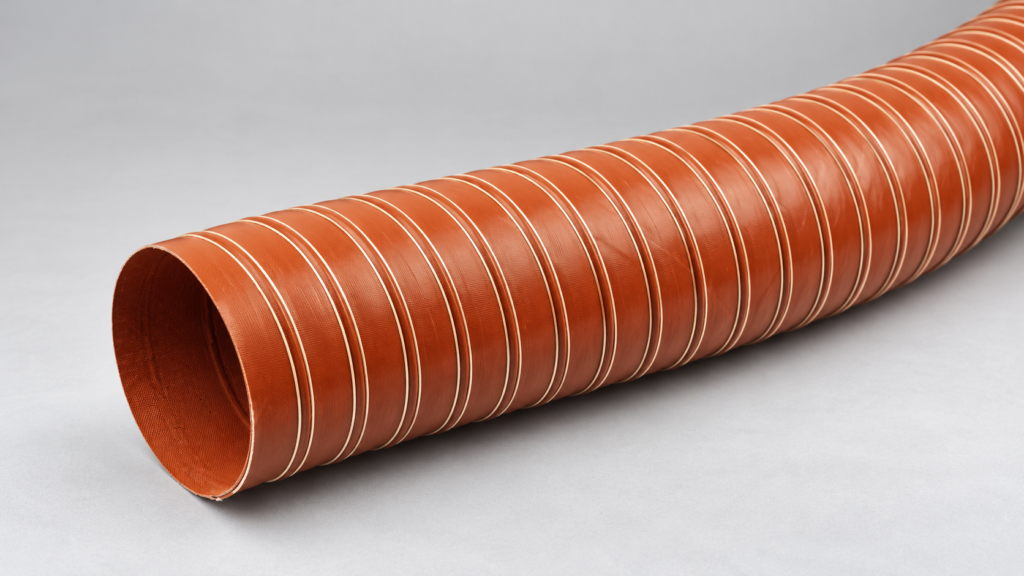
The term silicone hose covers products with different structures and intended uses. For an industrial air connection, identify whether the proposed product uses coated fabric, what reinforcement it contains and how the hose is intended to be connected.
RONDO offers Uni-silic designs within its vulcanised hose range. It also offers silicone-coated fabric constructions within the KLIN ventilation and ducting range. These families should be compared using their own model data.
A smooth solid-wall silicone tube and a fabric-reinforced flexible duct should not be specified as equivalent components on the strength of their shared material name. The intended medium and operating conditions need to be established for the actual product.
Compare Uni-silic and KLIN Silic constructions
The product information for Uni-silic A describes a single layer of silicone-coated glass fabric. Uni-silic B uses a double-layer construction. The range lists a copper-coated steel wire spiral as reinforcement.
KLIN Silic B uses silicone-coated fiberglass fabric with an external galvanized steel spiral. It is a separate construction and should not inherit the operating limits of the Uni-silic models.
| Model | Construction described by RONDO | Listed upper temperature |
| Uni-silic A | Single-layer silicone-coated glass fabric with wire spiral | +310°C |
| Uni-silic B | Double-layer silicone-coated glass fabric with wire spiral | +310°C |
| KLIN Silic B | Silicone-coated fiberglass fabric with external steel spiral | +250°C |
This comparison identifies differences in the range. It does not establish an interchangeable duty or a common pressure rating. Confirm the applicable conditions for the proposed model, diameter and installation. Our KLIN Silic B product article provides more information on that particular design.
Describe normal temperatures and operating peaks
State the temperature of the conveyed air during normal operation and any expected peaks. Explain how long a peak lasts and how often it occurs. Include the ambient conditions around the hose, especially where nearby equipment or a confined installation may affect exposure.
Do not describe the duty simply as “up to 300 degrees”. Specify the unit and distinguish normal operation from exceptional conditions. For an international enquiry, retaining the original values and units from the equipment documentation helps avoid ambiguity.
The supplier can then compare those conditions with the proposed hose data. A catalogue upper temperature is not, by itself, confirmation of suitability for every combination of pressure, movement and medium.
Check vacuum, pressure and dimensions for the selected model
An extraction connection needs to be reviewed against its vacuum conditions. Where pressure operation is intended, provide that requirement separately and verify it for the exact model. Do not assume that all silicone-coated fabric hoses share the same capability.
For example, the Uni-silic B product page lists dimensional and vacuum information for individual sizes and identifies room-temperature conditions for its catalogue parameters. Those values should not be transferred automatically to another model or treated as a combined hot-operation rating.
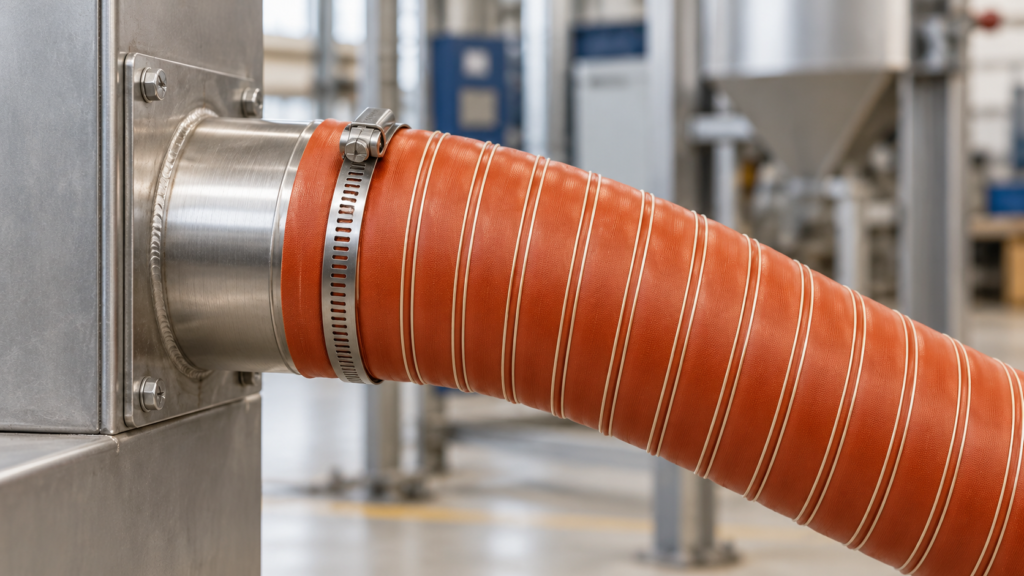
Provide the required internal diameter, length and connection geometry. Include the dimensions of the actual spigot or connecting component rather than relying on an outside measurement of the previous hose.
Consider chemical exposure separately from heat resistance
Hot air service and chemically demanding service raise different selection questions. If the conveyed air contains vapours or process contaminants, identify them as precisely as possible. Concentration, temperature and exposure duration can affect material suitability.
The RONDO chemical resistance table is a starting point for comparison, not a substitute for checking a complete hose against the actual process. It should not be used to assign universal chemical resistance to silicone.
Where the duty calls for a PTFE air hose or a chemical-resistant CSM hose, compare the relevant KLIN PTFE Teflo or KLIN CSM Hypa construction in the specialist ducting range. These are separate material options. Their suitability still depends on the particular medium and operating conditions; they are not features of a silicone hose.
Review the installation route and movement
Show the available space between the connection points and describe any movement. A hose that can be positioned during assembly may still experience excessive bending or other loads during operation.
Check the proposed routing against the required bending space and mounting arrangement. Include nearby edges, hot surfaces and access for inspection in the review. Where the hose is replacing a failed part, photographs of the damage can help explain whether the issue appeared at a bend, along the wall or at a connection.
Connection and support details should follow the documentation for the selected hose and the installation. The hose material alone does not determine how the complete connection should be assembled.
Application details to include in an enquiry
Prepare one consistent description covering:
the conveyed medium and any relevant vapours or contaminants;
normal temperature, expected peaks and surrounding conditions;
pressure or vacuum requirements;
internal diameter, length and connection dimensions;
routing, movement and available installation space;
any material, electrical or documentation requirements.
If a new process differs from the previous one, state the change explicitly. Repeating the old model designation is useful for identification, but it does not confirm that the same hose meets a revised duty.
Frequently asked questions about industrial silicone hoses
Is every silicone hose suitable for industrial hot air
No. Confirm the construction, intended use and operating limits of the particular product. A material name alone does not identify a suitable industrial air connection.
Do Uni-silic A and Uni-silic B have identical constructions
RONDO identifies single-layer and double-layer constructions respectively. Selection should also take account of the remaining technical data for the required model and size.
Can vacuum data at room temperature be used unchanged at maximum temperature
That combination must be checked with the supplier. Separate catalogue values do not automatically establish simultaneous operating performance at their respective limits.
Does heat resistance also confirm chemical compatibility
No. The chemical substances, their concentrations, the exposure conditions and the complete hose construction must be assessed separately.
Specify your industrial silicone hose with RONDO
Review the Uni-silic products in the vulcanised hose range and the available KLIN ducting constructions. Then send RONDO your application details to discuss the appropriate model, size and operating requirements.