
A replacement specification that says only “flexible metal hose” leaves several important questions unanswered. The hose may need to connect to an extraction system, follow a particular installation route or provide mechanical protection. Its steel type matters, but so do the profile construction and any sealing incorporated into that profile.
A stainless steel metal hose should be selected by checking the material, profile design and operating requirements together. Changing from galvanized to stainless steel does not automatically provide the required tightness or establish a pressure rating. This guide explains how to compare the options when preparing an industrial enquiry.
Separate the steel type from the hose construction
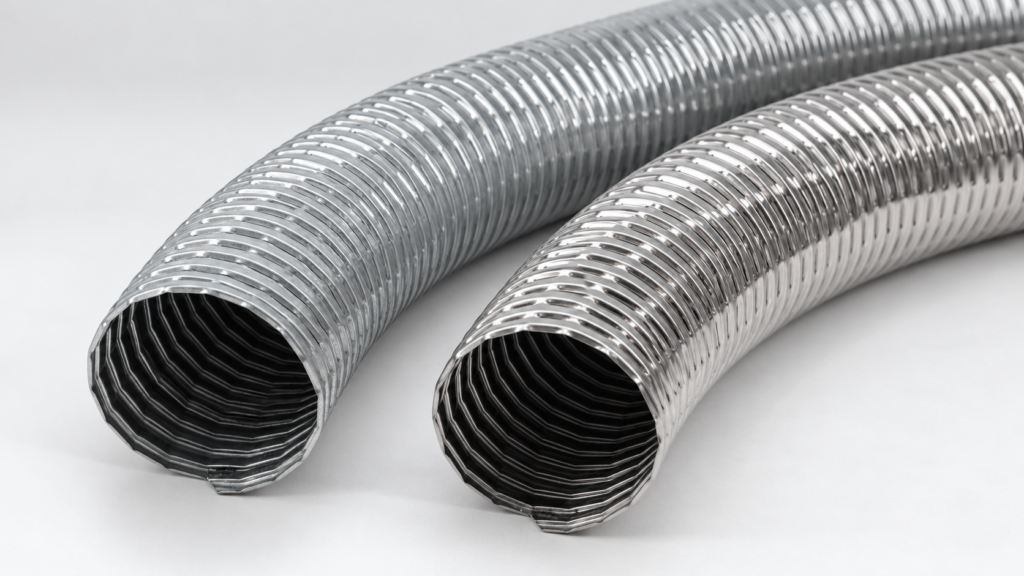
The wall material and the way a metal hose is constructed describe different aspects of the product. A material designation should therefore be recorded alongside the model name and profile details. Neither the word stainless nor the general term steel hose fully defines the component.
RONDO offers metal hoses made from galvanized and stainless steel. Its Metalhex range includes profiled constructions with different sealing options. These products should be evaluated using their own technical information, rather than treated as interchangeable with other metal hose designs.
For a broader introduction to hose types and their selection, see our guide to flexible metal hoses for industrial applications. The comparison below focuses on material and profile choices within the Metalhex range.
Describe the environment before choosing the material
Start with what the hose will encounter on both sides of its wall. The transported medium is one part of the description. Moisture, substances in the surrounding environment and cleaning conditions may also matter.
For a stainless steel metal hose enquiry, state the actual exposure conditions instead of requesting an unspecified “corrosion-resistant” product. Where the installation requires a particular steel grade or supporting document, include that requirement explicitly. Appearance and surface finish are not a reliable way to identify the material.
The same approach applies to a galvanized steel hose. Confirm that the proposed material is suitable for the duty, then examine the construction and operating limits. If the existing hose has deteriorated, photographs and a description of where the damage occurred can help distinguish external exposure from internal wear or mechanical damage.
Compare profile sealing as a separate requirement
Metalhex models are available with an unsealed profile, a silicone sealing element or fiberglass rope incorporated into the profile. Those distinctions should be part of the specification whenever leakage performance matters.
| Wall material | Profile option listed in the range | Metalhex models |
| Galvanized steel | Without profile sealing | Metalhex A |
| Galvanized steel | Silicone sealing element | Metalhex B |
| Galvanized steel | Fiberglass rope | Metalhex B1 |
| Stainless steel | Without profile sealing | Metalhex inox C |
| Stainless steel | Silicone sealing element | Metalhex inox D |
| Stainless steel | Fiberglass rope | Metalhex inox D1 |
These are construction options, not a guarantee that a hose is suitable for every medium or leakage requirement. RONDO states that the polygonal construction does not provide complete tightness. If the process requires a specified leakage limit, a gas-tight connection or a pressure-rated assembly, that requirement must be checked against the proposed product.
The Metalhex A product information describes its unsealed galvanized profile. Use the relevant model documentation when comparing another variant.
ZDJĘCIE 2 — W TREŚCI — BLOK REDAKCYJNY DO USUNIĘCIA
Check temperature against the complete model
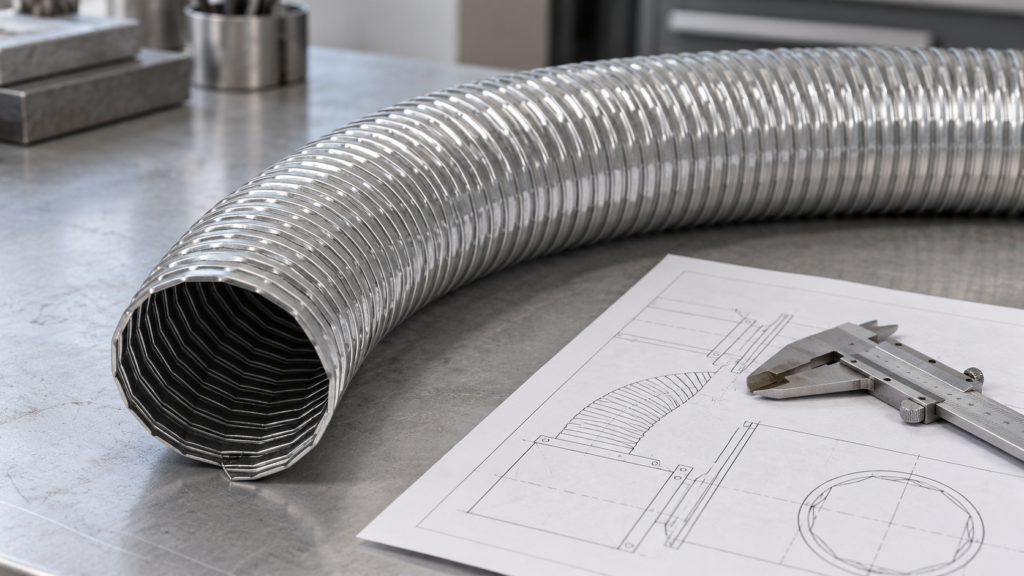
The steel type alone does not determine the temperature capability of the finished hose. Other construction elements, including profile sealing, must be considered.
For example, the RONDO range lists both Metalhex B in galvanized steel and Metalhex inox D in stainless steel with a catalogue temperature limit of +300°C. Both use a silicone sealing element. This illustrates why selecting stainless steel does not, by itself, establish a higher temperature limit for an assembled construction.
Provide the normal medium temperature, expected peaks and the conditions around the installation. Then check the applicable limits and operating conditions for the exact model. Catalogue values should not be combined with unverified assumptions about pressure, movement or chemical exposure.
Include dimensions and installation movement
Record the required internal diameter and the dimensions of the connecting equipment. If a hose is replacing another construction, matching the outside appearance or nominal size may not be sufficient to confirm fit.
Also describe the route, available bending space and any movement during operation. A connection that fits when the machine is stationary may experience different loads over its full operating movement. Bending radius, support and end connections belong in the same review as material selection.
For an international enquiry, give dimensions and units explicitly. If a drawing uses inches, state whether the value refers to an actual internal diameter, a nominal size or a connecting part. Keep catalogue dimensions and drawing dimensions identifiable rather than relying on an informal conversion.
Prepare a clear comparison request
A useful enquiry allows the proposed galvanized and stainless steel options to be compared against the same duty. Include:
the medium and relevant exposure conditions;
normal and peak temperatures;
required internal diameter, length and connection details;
pressure or vacuum conditions where applicable;
leakage requirements and any specified construction;
movement, available bending space and mounting arrangement;
required material identification or documentation.
For a replacement, add the previous model designation and explain why it is being changed. A request to improve service life should identify the observed problem, such as wear, damage at an end connection or deterioration in a particular area.
Frequently asked questions about metal hoses
Does stainless steel make a metal hose gas-tight
No. Tightness depends on the complete construction and its declared performance. The material name alone cannot establish a leakage limit. RONDO identifies a tightness limitation for its polygonal Metalhex construction.
Are profile-wound and corrugated metal hoses interchangeable
They should not be treated as equivalent without reviewing their technical specifications. Construction, connections, operating limits and intended use must all match the application.
Does a higher catalogue temperature mean a hose suits the whole process
Temperature is one selection criterion. Medium compatibility, mechanical conditions, leakage requirements and any applicable pressure or vacuum conditions must also be checked.
What is the most useful information for a replacement enquiry
Provide the model identification, installation dimensions, operating conditions and photographs of the existing arrangement. Describe any failure or wear instead of relying only on a request for a stronger hose.
Discuss your metal hose specification with RONDO
Compare the RONDO metal hose range against your installation requirements. Then contact RONDO with the material, profile and operating information needed to narrow the selection to a suitable model and size.