Industrial installations often require a connection that combines flexibility with mechanical durability and resistance to demanding operating conditions. In situations where a rigid duct cannot accommodate movement or installation geometry, and a conventional plastic hose does not provide the required thermal or mechanical properties, metal hoses can become an effective solution.
Flexible metal hoses are used in extraction, ventilation, material conveying, machinery and other industrial systems. However, selecting the right metal hose requires more than choosing the correct diameter.
Construction, metal type, sealing, bending behaviour, temperature, transported material and installation conditions all influence how the hose will perform in service.
What is a flexible metal hose?
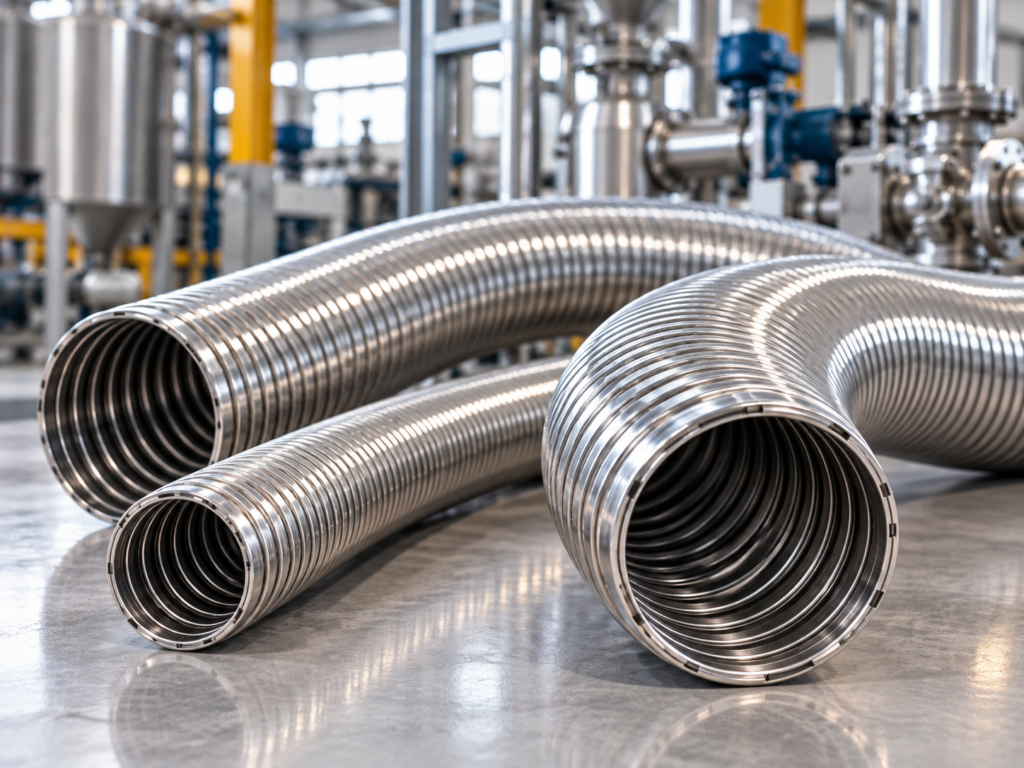
A flexible metal hose is a duct or conveying element whose wall is formed from a metal profile rather than a polymer or technical fabric.
The profiled construction allows the hose to bend while maintaining significantly greater mechanical and thermal resistance than many conventional flexible materials.
Depending on the design, a metal flexible hose may be manufactured from galvanized steel or stainless steel and may use additional sealing material between sections of the profile.
This construction is particularly useful where the hose must operate close to machinery, hot processes or abrasive conveyed materials.
RONDO’s current metal hose range includes galvanized-steel and stainless-steel variants, with both unsealed and sealed profile designs.
Where are metal hoses used?
Flexible metal hoses are suited to applications where one or several demanding factors occur simultaneously.
Extraction of hot air and gases
Processes involving hot air, fumes or gaseous media can exceed the practical temperature limits of many polymer hoses.
Depending on its construction, a steel hose can provide a much higher temperature capability.
This does not mean that every metallic hose is automatically suitable for any temperature. The allowable operating temperature must always be checked for the specific hose type.
Industrial ventilation
A flexible metallic section can connect rigid ventilation components where a completely fixed pipeline would be difficult to install.
It can also help accommodate geometry changes between machine outlets and fixed ductwork.
Abrasive bulk material transport
Some metal hose constructions are intended for transporting loose abrasive materials.
In these applications, wear behaviour, internal profile and sealing need to be considered together with material velocity and particle characteristics.
Machinery and moving equipment
Machines generate vibration and can require small movements between connected components.
A flexible section allows these components to be connected without relying entirely on rigid pipework.
Galvanized steel or stainless steel?
Material selection is one of the fundamental decisions when choosing an industrial metal hose.
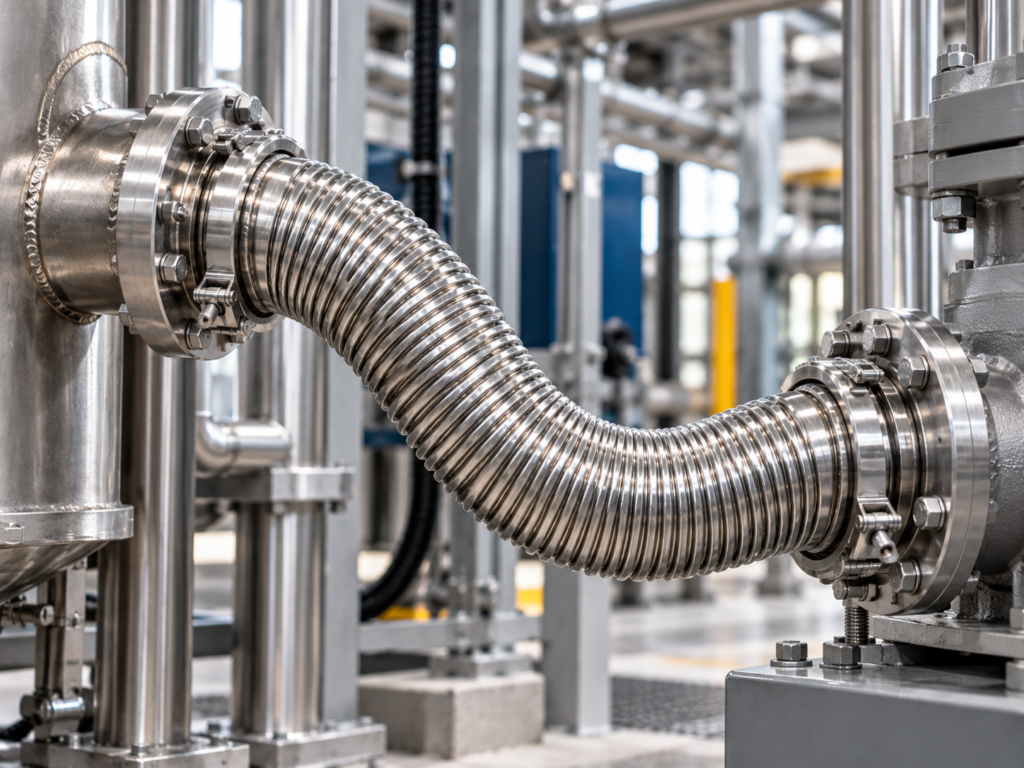
Galvanized steel can provide a robust and economical solution for many extraction, ventilation and conveying systems.
Stainless steel is typically considered when the application places greater demands on corrosion resistance, thermal resistance or the operating environment.
The final decision should therefore be based on actual operating conditions rather than material name alone.
RONDO manufactures metal hose variants in both galvanized and stainless steel, with the individual constructions designed for different operating requirements.
Why profile construction matters
Unlike a smooth rigid pipe, a flexible metallic hose obtains much of its flexibility from the geometry of its wall.
The profile allows adjacent sections of the hose to move relative to each other while maintaining the overall duct shape.
This creates a compromise between flexibility and structural stability.
The exact construction influences bending behaviour, mechanical durability and leakage characteristics.
A very important point is that a profiled flexible metal hose should not automatically be treated as a completely airtight pipeline. RONDO explicitly notes that the polygonal design of its metal hoses does not provide 100% tightness.
That distinction becomes important when designing systems for gases, dust extraction or processes in which controlled leakage is critical.
Sealed and unsealed metal hoses
One of the most important construction differences is the use of sealing between metal profiles.
An unsealed hose can be suitable for applications such as air extraction or gravity transport, depending on process requirements.
A sealed construction can provide different operating characteristics and may be preferred where transported material or application conditions require additional sealing.
The sealing material itself also matters because it can change the allowable operating temperature.
This is why “metal hose” should never be treated as one universal product type.
How to select the correct metal hose diameter
Diameter affects both installation compatibility and flow behaviour.
The hose must fit the machine connection, but using the existing connector diameter as the only selection criterion can be insufficient.
The required airflow or material flow, total duct length, bends and restrictions in the system all influence pressure loss.
For extraction systems in particular, reducing the diameter without considering system performance can increase resistance and reduce extraction efficiency.
When replacing an existing hose, it is therefore worth confirming whether the original diameter was selected correctly for the process rather than simply copying it.
Temperature: look at the complete system
Metal hoses are often selected specifically because of temperature.
But temperature selection needs to consider more than the nominal temperature of the transported medium.
The designer should also evaluate ambient temperature, radiant heat, temporary temperature peaks and the temperature limits of seals, clamps and connecting components.
Selected RONDO metal hose variants are designed for temperatures reaching up to +500°C or +650°C, while silicone-sealed variants have lower stated maximum values. The exact limit depends on construction and material.
This is a good example of why the metal wall alone does not determine the operating limit of the complete hose.
Flexibility and bending radius
A hose is flexible, but it is not infinitely flexible.
Installation should avoid excessively tight bends, deformation immediately next to the connection and unnecessary mechanical stress.
The required routing should be considered before selecting hose diameter and construction.
A hose that operates comfortably within its intended geometry will generally work more predictably than one that is permanently forced into an extreme bend.
Metal hose versus PUR or PVC hose
Metal, polyurethane and PVC hoses serve different purposes.
PVC can be effective for many general extraction and ventilation applications.
PUR is often selected where flexibility and abrasion resistance are particularly important, for example when conveying dust, chips or granulate.
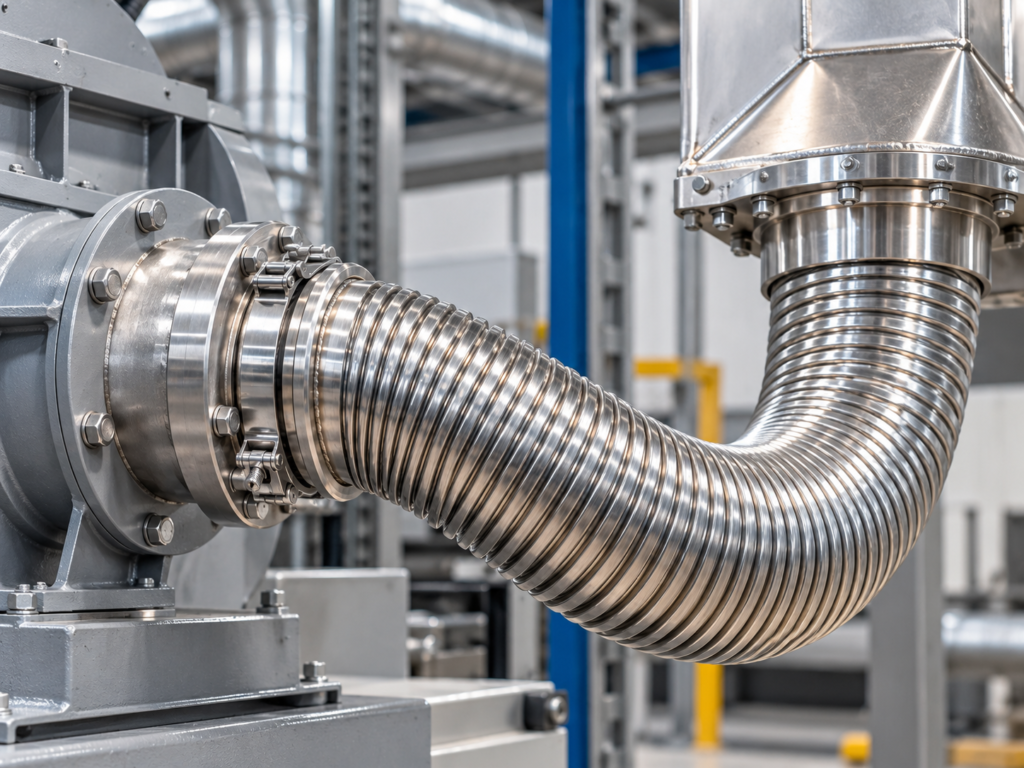
Metal becomes especially relevant when higher thermal loads, demanding mechanical conditions or metallic construction are required.
The correct question is therefore not “which material is best?” but rather “which material matches the operating conditions of the system?”
What information should be defined before ordering?
A technical selection is much easier when the application is clearly described.
The most useful information includes the required internal diameter, medium, operating and maximum temperature, whether the installation works under pressure or vacuum, type of abrasive material if present, expected movement, available installation space and connection method.
For unusual installations it is also worth establishing whether a non-standard diameter or customised connection is required.
Flexible metal hoses from RONDO
RONDO manufactures metal hoses for industrial applications in galvanized and stainless-steel variants.
The range includes different profile and sealing configurations, enabling the hose to be matched to extraction, ventilation, high-temperature and abrasive-material applications.
Metal hoses for industrial applications
Instead of selecting a hose only by nominal diameter, compare the actual operating requirements with the technical data of the individual product.
This reduces the risk of selecting a hose that fits mechanically but does not meet the thermal, mechanical or process requirements of the installation.
Frequently asked questions
What are flexible metal hoses used for?
They are commonly used in extraction, ventilation, machinery and selected material-conveying applications where flexibility, mechanical durability or elevated temperature resistance are required.
Are all metal hoses suitable for high temperatures?
No. Temperature resistance depends on the wall material, profile design and sealing system. Product-specific technical data should always be checked.
What is the difference between galvanized and stainless-steel metal hoses?
Both materials can provide mechanically robust flexible ducting, but stainless steel is typically selected when operating conditions place greater demands on corrosion or temperature resistance.
Can a metal hose transport abrasive materials?
Certain designs are intended for conveying loose abrasive materials. The exact hose should be selected according to the material, operating conditions and expected wear.
Is a flexible metal hose completely airtight?
Not necessarily. Flexible profiled constructions may not provide complete gas-tightness. If tightness is critical, this requirement must be considered during product selection.
How do I choose between a metal hose and a PUR hose?
The choice depends on temperature, abrasion, flexibility, mechanical conditions and the transported medium. PUR is frequently used for abrasive extraction and conveying, while metal solutions become particularly relevant under higher thermal or mechanical loads.